

Hey ho! So I have been extremely busy lately, no doubt as many of you have noticed. I've stopped playing EVE Online and many other games to focus on my Uni and Business work. And luckily, I've got both of these out the way, the Uni because I'm finished, and my Business because I've taken a leave of absence.
The reason being? Exams!! My Univeristy Third year exams start on Wednesday, and go on for three weeks (two per week). I have my last exam on the 29th May, and from that date I am completely finished with University (I think, I might still get my Viva sometime in early June, we'll have to see...)
Anyhow, I'm only a month away from finishing my three year degree at Goldsmiths! So obviously, I have taken a break to pour every ounce of available energy into gaining this degree. Still, I have managed to find a little bit in my breaks to post this blog entry informing you all that I still live, and that I haven't forgotten my blog.
I've just been too busy to do anything else but work, and am now too busy to do anything else but revise!!
P.S. I will be organising my labels for the posts soon into various categories. Hopefully :)
Tuesday, 12 May 2009

Monday, 16 March 2009
Reset Button time... Again!
Yo blog readers! I know what you are thinking! Another random blog out of the blue around a month after the last one and to be followed by more silence of a similar length. I always seem to open my latest blog post with 'I haven't posted for a long time because...' and I seem to have done it again! Well I am a busy person after all :P
Anyway, it's time once again to hit that reset button and try to start blogging more often. So, let me continue this blog post with what I've been up to over the past month or so since my last blog post...
Well, for work I've been doing a lot for the company I work for as well as a lot in my Uni project. I still have a lot of work to do in both, so I'm going to be busy on these two for a little while longer. On top of that, of course, I have all the lectures and assignments my other Uni courses are providing me with, so all in all work is really keeping me on my toes.
In my free time, I'm usually spending a lot of it browsing the latest news feeds and keeping an eye on Facebook and Twitter (see my blog post here if you want to know what Twitter is) , with the help of my trusty iPhone. I've also been watching anime and Star Trek DS9 a lot when I'm a little too tired to think. And of course one shouldn't forget the USS Andromeda!
That's not to mention I'm not busy at home too. I still have my usual duties to complete here and there. On top of all this, I am also going to the gym once or twice a week to do weights. Trying to build up some muscle! I have my own personal trainer who helps me with the weights and stuff.
So as you can tell I have very good reasons for my infrequent blog posts. I do have interesting things to blog about; it's just I need to find the time to blog it!
Anyhow, until the next long and distant blog entry, I'll sign off.
-- Post From My iPhone
Anyway, it's time once again to hit that reset button and try to start blogging more often. So, let me continue this blog post with what I've been up to over the past month or so since my last blog post...
Well, for work I've been doing a lot for the company I work for as well as a lot in my Uni project. I still have a lot of work to do in both, so I'm going to be busy on these two for a little while longer. On top of that, of course, I have all the lectures and assignments my other Uni courses are providing me with, so all in all work is really keeping me on my toes.
In my free time, I'm usually spending a lot of it browsing the latest news feeds and keeping an eye on Facebook and Twitter (see my blog post here if you want to know what Twitter is) , with the help of my trusty iPhone. I've also been watching anime and Star Trek DS9 a lot when I'm a little too tired to think. And of course one shouldn't forget the USS Andromeda!
That's not to mention I'm not busy at home too. I still have my usual duties to complete here and there. On top of all this, I am also going to the gym once or twice a week to do weights. Trying to build up some muscle! I have my own personal trainer who helps me with the weights and stuff.
So as you can tell I have very good reasons for my infrequent blog posts. I do have interesting things to blog about; it's just I need to find the time to blog it!
Anyhow, until the next long and distant blog entry, I'll sign off.
-- Post From My iPhone
Friday, 13 February 2009
Into 2009: A Blog Update
It's been a long time since I've posted a blog entry. The reason being that I've been extremely busy. Even too busy to play games as often as I'd like as well, as my EVE Online Corp would know...
So! What have I been up to then? Well...
For starters the development of my Uni's third year project is well underway. It is quite a large project though and I'm not sure that I'm going to be able to meet all it's goals entirely by the time I have to finish it... but that's not too big a problem for the general public as I can easily expand it now I've got a stable framework.
The other large project that I'm working on is for the company I work for, worldflow. I am creating Java and PHP based web services for the project I'm working on using quite a few technologies I've only just met (not used to create the services, I know how to do that, but to organize all the code properly...)
Put those two large projects which take up the majority of my time anyhow, on top of my Uni, with it's lectures, labs and other assignments; the home based duties I have; the gym I'm just getting into; quite a few trips here and there; and watching Star Trek DS9 with my brother, and you'll begin to understand what's taking up my time.
I've also been keeping everyone up to date on my progress through other means. That is, through Twitter and (sometimes) Facebook. This often done from the comfort of my iPhone! In fact, I posted this very blog post using an iPhone app called BlogPress, a fantastic blogging app that hasn't crashed once despite the reviews that say otherwise.
Needless to say I use my iPhone a lot. In fact, with over 1GB worth of apps, I've actually reached the maximum number of pages of apps allowed by Apple: 9 pages of apps (that's just under 144 apps on my iPhone!)
Anyway, as this is the second time I've written this blog post (previous version lost during posting due to lack of Internet; my fault entirely) I will finish here. Hopefully with this new iPhone app I should be able to post more reguarly, but time will tell!
Until next time... Live Long and Prosper!
-- Post From My iPhone
So! What have I been up to then? Well...
For starters the development of my Uni's third year project is well underway. It is quite a large project though and I'm not sure that I'm going to be able to meet all it's goals entirely by the time I have to finish it... but that's not too big a problem for the general public as I can easily expand it now I've got a stable framework.
The other large project that I'm working on is for the company I work for, worldflow. I am creating Java and PHP based web services for the project I'm working on using quite a few technologies I've only just met (not used to create the services, I know how to do that, but to organize all the code properly...)
Put those two large projects which take up the majority of my time anyhow, on top of my Uni, with it's lectures, labs and other assignments; the home based duties I have; the gym I'm just getting into; quite a few trips here and there; and watching Star Trek DS9 with my brother, and you'll begin to understand what's taking up my time.
I've also been keeping everyone up to date on my progress through other means. That is, through Twitter and (sometimes) Facebook. This often done from the comfort of my iPhone! In fact, I posted this very blog post using an iPhone app called BlogPress, a fantastic blogging app that hasn't crashed once despite the reviews that say otherwise.
Needless to say I use my iPhone a lot. In fact, with over 1GB worth of apps, I've actually reached the maximum number of pages of apps allowed by Apple: 9 pages of apps (that's just under 144 apps on my iPhone!)
Anyway, as this is the second time I've written this blog post (previous version lost during posting due to lack of Internet; my fault entirely) I will finish here. Hopefully with this new iPhone app I should be able to post more reguarly, but time will tell!
Until next time... Live Long and Prosper!
-- Post From My iPhone
Tuesday, 27 January 2009
eReader for iPhone
I will hopefully be bringing you up to date on what I've been up to recently in the next few days. I've just been so busy on my project and other Uni and work-based work lately that I haven't had much time to do much else, although my project is coming along quite nicely.
Anyway, down to this blog post which is a special blog entry that has been requested by a friend of mine on how to best use eReader for iPhone / iTouch, with screenshots! So let's get started.
Installing eReader on the iPhone
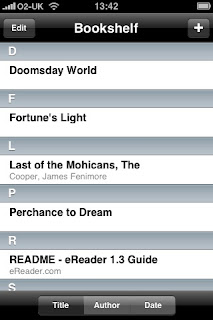
To install eReader on your iPhone, you require the iPhone firmware Version 2.0 or higher. If you don't have this firmware (found in Settings > General > About) you will have to update your iPhone through iTunes.
If you have the firmware, then you can install the app by either using the App Store located on the iPhone or through iTunes. Through iTunes, you can simply click on this link (iTunes link) to reach the iTunes page. Through the App Store, search for "eReader" and it's the first option.
When you have installed eReader, opening the app should get something similar to the following screen above.
Creating an eReader.com account
To upload any new eBooks to your iPhone eReader app, you need an account on the eReader.com website. Go ahead and create one of these now by following this link. Once you have successfully created an account, you can login to your eReader.com account and move to the next section.
Adding eBooks to your eReader.com Bookshelf
Once you have logged into eReader.com, at the top of the website, look for a link called "Bookshelf".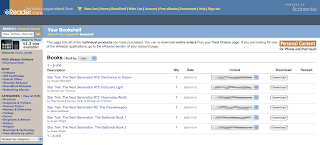 Click on this link and it will take you to a page that looks similar to the image on the left. If you haven't bought any eBooks off eReader, this page will be empty. Any books you do buy off eReader can be found here.
If you want to add your own eBooks to your bookshelf, you can click on the link found in the top-right of that page that looks like the image on the right. Note that eBooks must be in .pdb format. If they aren't, you will have to download an eBook converter. The converter I use and recommended is from Stanza, and is Stanza's desktop client. You can also download Stanza from iTunes, and this is yet another good eBook app I highly recommend. More on how to convert can be found later on in this tutorial.
Clicking on the personal content link on the eReader.com website will take you to a page that is like a private section of your Bookshelf, and will allow you to upload your eBooks into your Bookshelf. You have 25 MBs to play with, and you can always delete eBooks off the website if you need to and they won't be removed from your iPhone / iTouch. So the space isn't a big deal unless you are trying to transfer eBooks bigger then 25MBs in size at any one time.
Transferring eBooks to your iPhone
Once you have all the eBooks you want on your Bookshelf, you can transfer them to your iPhone / iTouch. Your iPhone / iTouch will need to be connected to the Internet in order to achieve this, and you should be logged into the eReader.com website.
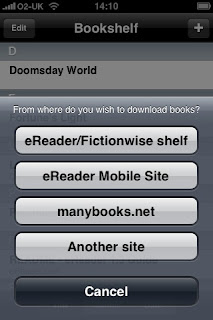 First, open eReader and click on the + button in the top right. You will be presented with the following screen shown on the left. Choose the option at the top of the screen labelled "eReader/Fictionwise shelf" and enter your eReader.com account details.
On the next screen, your iPhone will load in a list of all the books it can find on your Bookshelf, both from the eReader's bought books section and any books you've uploaded to your personal content section. Tapping on any book will ask if you wish to download the book to your library, which, if you accept, will promptly do so and respond with a message once it's downloaded.
eBooks on your eReader account will remain there until deleted off the iPhone. That means that even if you delete your eBooks off your Bookshelf on the eReader.com website, they will still remain on your eReader on iPhone's Bookshelf until you have deleted them there also, and vice versa. These two Bookshelf's are completely independent.
A final note before I end this section. eReader flourishes best with eBooks; that is, text. It doesn't do so well with multimedia .pdf files or the like. If you are looking for an app that does, you should try out Air Sharing (iTunes link) instead.
Converting eBooks with Stanza Desktop
The final section, as promised, is on Stanza desktop. Once you have downloaded and installed Stanza desktop, to convert simply open any file that Stanza opens (and it supports a lot of formats!) and then go to File > Export Book As... > Palm Database. You can give your new .pdb file a name, save it in a secure location on your computer, and then upload the file to your personal eBook area on eReader.com.
Final Notes
I hope this quick sweep through eReader has been helpful for you! Feel free to leave any comments and I will get back to you as soon as I can. And of course, hopefully I will get back into regular blog posting soon!
Anyway, down to this blog post which is a special blog entry that has been requested by a friend of mine on how to best use eReader for iPhone / iTouch, with screenshots! So let's get started.
Installing eReader on the iPhone

To install eReader on your iPhone, you require the iPhone firmware Version 2.0 or higher. If you don't have this firmware (found in Settings > General > About) you will have to update your iPhone through iTunes.
If you have the firmware, then you can install the app by either using the App Store located on the iPhone or through iTunes. Through iTunes, you can simply click on this link (iTunes link) to reach the iTunes page. Through the App Store, search for "eReader" and it's the first option.
When you have installed eReader, opening the app should get something similar to the following screen above.
Creating an eReader.com account
To upload any new eBooks to your iPhone eReader app, you need an account on the eReader.com website. Go ahead and create one of these now by following this link. Once you have successfully created an account, you can login to your eReader.com account and move to the next section.
Adding eBooks to your eReader.com Bookshelf
Once you have logged into eReader.com, at the top of the website, look for a link called "Bookshelf".
 Click on this link and it will take you to a page that looks similar to the image on the left. If you haven't bought any eBooks off eReader, this page will be empty. Any books you do buy off eReader can be found here.
If you want to add your own eBooks to your
 bookshelf, you can click on the link found in the top-right of that page that looks like the image on the right. Note that eBooks must be in .pdb format. If they aren't, you will have to download an eBook converter. The converter I use and recommended is from Stanza, and is Stanza's desktop client. You can also download Stanza from iTunes, and this is yet another good eBook app I highly recommend. More on how to convert can be found later on in this tutorial.
Clicking on the personal content link on the eReader.com website will take you to a page that is like a private section of your Bookshelf, and will allow you to upload your eBooks into your Bookshelf. You have 25 MBs to play with, and you can always delete eBooks off the website if you need to and they won't be removed from your iPhone / iTouch. So the space isn't a big deal unless you are trying to transfer eBooks bigger then 25MBs in size at any one time.
Transferring eBooks to your iPhone
Once you have all the eBooks you want on your Bookshelf, you can transfer them to your iPhone / iTouch. Your iPhone / iTouch will need to be connected to the Internet in order to achieve this, and you should be logged into the eReader.com website.
 First, open eReader and click on the + button in the top right. You will be presented with the following screen shown on the left. Choose the option at the top of the screen labelled "eReader/Fictionwise shelf" and enter your eReader.com account details.
On the next screen, your iPhone will load in a list of all the books it can find on your Bookshelf, both from the eReader's bought books section and any books you've uploaded to your personal content section. Tapping on any book will ask if you wish to download the book to your library, which, if you accept, will promptly do so and respond with a message once it's downloaded.
eBooks on your eReader account will remain there until deleted off the iPhone. That means that even if you delete your eBooks off your Bookshelf on the eReader.com website, they will still remain on your eReader on iPhone's Bookshelf until you have deleted them there also, and vice versa. These two Bookshelf's are completely independent.
A final note before I end this section. eReader flourishes best with eBooks; that is, text. It doesn't do so well with multimedia .pdf files or the like. If you are looking for an app that does, you should try out Air Sharing (iTunes link) instead.
Converting eBooks with Stanza Desktop
The final section, as promised, is on Stanza desktop. Once you have downloaded and installed Stanza desktop, to convert simply open any file that Stanza opens (and it supports a lot of formats!) and then go to File > Export Book As... > Palm Database. You can give your new .pdb file a name, save it in a secure location on your computer, and then upload the file to your personal eBook area on eReader.com.
Final Notes
I hope this quick sweep through eReader has been helpful for you! Feel free to leave any comments and I will get back to you as soon as I can. And of course, hopefully I will get back into regular blog posting soon!
Saturday, 20 December 2008
Countdown to Christmas
Christmas is fast approaching from all sides. This year, it really does seem to be sneaking up on me. Oh well... I will of course keep you up to date on all the happenings.
Since I got back from Computer Science 2008, I spent Thursday just relaxing around catching up on a few things, Friday organising what I need to get done and then tidying up the house a bit, then playing on EVE before going to watch a movie. Today I woke up late and have spent the morning playing with my younger brothers, Logan and Byron.
All in all, I've had quite a few unproductive days. So hopefully in the next coming week I can actually get some real work done. Anyway, until my next blog post!
Since I got back from Computer Science 2008, I spent Thursday just relaxing around catching up on a few things, Friday organising what I need to get done and then tidying up the house a bit, then playing on EVE before going to watch a movie. Today I woke up late and have spent the morning playing with my younger brothers, Logan and Byron.
All in all, I've had quite a few unproductive days. So hopefully in the next coming week I can actually get some real work done. Anyway, until my next blog post!
Wednesday, 17 December 2008
Computer Science 2008 - Day 3
Today was truely driven to research in the field, for everything we visited was trying to drive the field of computing forward. After waking up early once again, and having breakfast, we headed straight to the first talk, that of our chosen industrial challenge related to the future!
Some of these problems include developing technology to support airspace design (the design of airspace to be more efficient and 3D made); modelling airspace change for safety, environment and delay, and whole network modelling and management, among others. They also pointed to SESAR as a major european research group, and the fact that research delivers both business benefits and opportunities, alongside increasing relationships with the universities that are researched with.
The next speech was on industrial research from BT, labelled BT Innovate. BT have 100 years of innovation behind them, the infrastructure to show for it, and the ability to provide numerous services to customers. In fact, BT takes an extremely low proportion of it's profits from the standard telephone numbers, so it is suffice to say that BT is no longer just a telephone service company, but a whole lot more.
The technology that BT offer include the development of fibre optics, which make things go further and faster, and the design of the 21st century network with new service capabililities on one network (a single IP network). As such, BT have migrated to this new network infrastructure to be able to offer more, better. But they still need more improvements. They still want to offer more high value services utilising the ever growing Internet usage over the next few years.
After a short break, we moved on to interdisciplinary research challenges. These include computer use in other sciences (or even beyond sciences) and look at big questions. The different strands are below:
Track A started off with Engineering, which is said to be quite dependent on computing nowadays, in things such as CAD, solar-powered car's, satellites and modelling. We looked at how computers were utilised in real-world engineering environments, and particularly looked into agriculture, or precisely, "precision agriculture". This utilised computer vision (which enables computers to see) and the processing of digital images as signals for decisions, measurements and control. This is useful in agriculture to enable automated robots that are environmentally friendly and can look after, spray and de-weed the crops.
The robot used GIS/GPS to get the vehicle to the field, then would use the camera to locate individual plants. This would then enable real-time navigation and spraying. To detect the plants, a bandwidth detector is used (so dark colours would be the dirt, white colours the plants) and with a bit of processing (such as removing small objects and passing the results through a Kalman filter), the plants and their boundaries can be found and identified. Then, these plants can be checked whether they are weeds or not.
If you are interested more on this technology, you can view the Silsoe Research Institute and also view the Tillet and Hague Technology site (the robot we looked at was the Autonomous Crop Treatment Vehicle, which you can watch a video of there).
The next talk was on nanotechnology. This looked at technology that was being developed at nanometre size. To the layman, a nanometer is the length the fingernail grows in a second. Nanotechnology is the ability to measure and manipulate matter at submicron scales, and is applicable to Moore's Law.
With everything becoming more powerful and yet smaller, heat is an increasing problem. But there is also a problem with physics that can't be worked around. This is due to the limit of the size of atoms. The challenges for nanotechnology are to continue Moore's Law while going around current physical limits and keeping this all within a reasonable price range. This can be done using new devices and fabrication paradigms.
For example, the use of a single atom memory can be done using salts and not silicon, due to the increase in ions. Electronics can also be self-assembled, and the use of bio electronics can come together to help as well (using biological organisms to develop technology at a nanoscopic level). This could also be solved by rewriting software, but with increasingly complex systems this means increasingly complex software.
After lunch, we were presented with the final talk... on Quantum Computing. Unfortunately, I am not very good at mathematics or physics, and so this topic was way over my head. If you are a computer scientist who is interested in mathematics and/or physics and are good at it, then this subject may interest you more. And if you want to understand more on what was presented, then speak to Saqib. He understood it a lot more then most people there!
Before I close off this conference, I would like to provide a few more photo's of various locations around the college that I took at various times. First, a few of the external:
 The main building at night

 Then, I also took a few of the rooms that were offered to us. This of course is not representative in any way of the entire university rooms, but just gives a small insight into the rooms we stayed in:
 A nice bed
 The desk in the room (with more shelves going up)
 The phone - it's an IP Phone!
 En-Suite Bathroom! Each!


Overall, this entire experience has been wonderful! It has been extremely worth attending, and I have not been disappointed by anything presented to me during my time here. It was all completely awesome and fascinating at the same time! To also meet so many wonderful people who are fellow Computer Scientist's in the field (including so many cool professors and businessmen) was an honour indeed. I had a great time and, if asked, would most certainly go again!! Thanks to Goldsmiths College, London, for giving me the oppourtunity to go, and to the conference organisers for such a fabulous conference; you know who you all are! :)
And that's me signing off. Phew!
- Track A: Industrial Challenge Session 1
- Air Traffic Control
- The Changing Face of Industrial Research
- Track B:Industrial Challenge Session 2
- Finance
- Service Oriented Computing
- Track C: Panel - Research Careers
Some of these problems include developing technology to support airspace design (the design of airspace to be more efficient and 3D made); modelling airspace change for safety, environment and delay, and whole network modelling and management, among others. They also pointed to SESAR as a major european research group, and the fact that research delivers both business benefits and opportunities, alongside increasing relationships with the universities that are researched with.
The next speech was on industrial research from BT, labelled BT Innovate. BT have 100 years of innovation behind them, the infrastructure to show for it, and the ability to provide numerous services to customers. In fact, BT takes an extremely low proportion of it's profits from the standard telephone numbers, so it is suffice to say that BT is no longer just a telephone service company, but a whole lot more.
The technology that BT offer include the development of fibre optics, which make things go further and faster, and the design of the 21st century network with new service capabililities on one network (a single IP network). As such, BT have migrated to this new network infrastructure to be able to offer more, better. But they still need more improvements. They still want to offer more high value services utilising the ever growing Internet usage over the next few years.
After a short break, we moved on to interdisciplinary research challenges. These include computer use in other sciences (or even beyond sciences) and look at big questions. The different strands are below:
- Track A
- Engineering
- Nanosystems
- Track B
- Open Data in Science (Cancelled)
- Physics
- Track C
- Biosciences
- Medicine
- Track D
- Psychology
- Humanities
Track A started off with Engineering, which is said to be quite dependent on computing nowadays, in things such as CAD, solar-powered car's, satellites and modelling. We looked at how computers were utilised in real-world engineering environments, and particularly looked into agriculture, or precisely, "precision agriculture". This utilised computer vision (which enables computers to see) and the processing of digital images as signals for decisions, measurements and control. This is useful in agriculture to enable automated robots that are environmentally friendly and can look after, spray and de-weed the crops.
The robot used GIS/GPS to get the vehicle to the field, then would use the camera to locate individual plants. This would then enable real-time navigation and spraying. To detect the plants, a bandwidth detector is used (so dark colours would be the dirt, white colours the plants) and with a bit of processing (such as removing small objects and passing the results through a Kalman filter), the plants and their boundaries can be found and identified. Then, these plants can be checked whether they are weeds or not.
If you are interested more on this technology, you can view the Silsoe Research Institute and also view the Tillet and Hague Technology site (the robot we looked at was the Autonomous Crop Treatment Vehicle, which you can watch a video of there).
The next talk was on nanotechnology. This looked at technology that was being developed at nanometre size. To the layman, a nanometer is the length the fingernail grows in a second. Nanotechnology is the ability to measure and manipulate matter at submicron scales, and is applicable to Moore's Law.
With everything becoming more powerful and yet smaller, heat is an increasing problem. But there is also a problem with physics that can't be worked around. This is due to the limit of the size of atoms. The challenges for nanotechnology are to continue Moore's Law while going around current physical limits and keeping this all within a reasonable price range. This can be done using new devices and fabrication paradigms.
For example, the use of a single atom memory can be done using salts and not silicon, due to the increase in ions. Electronics can also be self-assembled, and the use of bio electronics can come together to help as well (using biological organisms to develop technology at a nanoscopic level). This could also be solved by rewriting software, but with increasingly complex systems this means increasingly complex software.
After lunch, we were presented with the final talk... on Quantum Computing. Unfortunately, I am not very good at mathematics or physics, and so this topic was way over my head. If you are a computer scientist who is interested in mathematics and/or physics and are good at it, then this subject may interest you more. And if you want to understand more on what was presented, then speak to Saqib. He understood it a lot more then most people there!
Before I close off this conference, I would like to provide a few more photo's of various locations around the college that I took at various times. First, a few of the external:
A view from my room
 The main building at night

 Then, I also took a few of the rooms that were offered to us. This of course is not representative in any way of the entire university rooms, but just gives a small insight into the rooms we stayed in:
Our first impression
 A nice bed
 The desk in the room (with more shelves going up)
 The phone - it's an IP Phone!
 En-Suite Bathroom! Each!

Overall, this entire experience has been wonderful! It has been extremely worth attending, and I have not been disappointed by anything presented to me during my time here. It was all completely awesome and fascinating at the same time! To also meet so many wonderful people who are fellow Computer Scientist's in the field (including so many cool professors and businessmen) was an honour indeed. I had a great time and, if asked, would most certainly go again!! Thanks to Goldsmiths College, London, for giving me the oppourtunity to go, and to the conference organisers for such a fabulous conference; you know who you all are! :)
And that's me signing off. Phew!
Tuesday, 16 December 2008
Computer Science 2008 - Day 2
I woke up at around 7:15 this morning, having set a few alarms to wake me up then. Breakfast was in the great hall, and was a nice buffet of stuff (pastries, and the full English breakfast). By 9am, we were all back in the auditorium for today's first speech on procrastination, called The Power of Procrastination. This was spoken to us by Jorge Cham, who is the same guy who has created the comic Piled Higher and Deeper.

The speech itself was extremely funny and well put together, and utilised Jorge's comic strip character's. All I will say regarding the speech is that procrastination is not like laziness. Laziness is not doing the things you have to do; where as procrastination is not doing the things we have to do, now! For the rest of the speech though, you really need the wit and charm of Jorge himself.
Next up was the first set of mini tutorials for that day. We had a wide range of different tutorials on offer, as listed below:
The systems themselves should change/update their behaviour dynamically in response to changes, without a human's aid. Such as self-configuring themselves, self-healing and self-tuning. This would follow the basic architecture of Collect -> Analyse -> Decide -> Act -- Feedback Loop (although this was the early model and later models compressed this into Controller, Sequencer and Deliberator) with the three-layer architecture model.
There were a few examples with the cat and mouse game (where the cat and mouse can't be in the same room, and the controller must manage this without human intervention) and the Koala example (with a robot that had to take a ball from one location to another). This really was a most fascinating and enjoyable tutorial; creating a networked community of self-autonomous robot's (even virtual robots) would be so enjoyable!
After lunch, we got another wide multiple choice, this time in a group of workshops:
Basically, Google works off decades of Computer Science research, most of which is intertwined with engineering. The user's view of Google is to organise the world's information to make it more accessible and organisable. However, there are large design challenges for that, including the vast scale, huge data growth, wide geographical distribution and the huge latency challenge that Google has set themselves (getting search results and the like delivered to the user "in a blink of an eye".
Google has a vast number of highly efficient servers in highly efficent data centres (they use huge water cooling). These data centres (which are actually warehouse-scale computers) off extremely fast responses and are highly managed. Google is extremely efficient in whatever they do; trying to keep waste to a minimum and recycling all waste they produce.
They also have fast moving applications, good OS System design (using Linux), loosely-coupled distributed systems, distributed data storage, processing and interpretation, and use a wide variety of programming languages (including but not limited to, C++, Java, Python and Javascript). But it's the way they do software development that fascinates me...
They have small teams that use an agile "launch and iterate" philosophy (that is launch internally). Once a product is launched, any engineer across the entire codebase (that is any engineer in Google!) can work on the code. This may seem completely chaotic, as with people working in small teams all editing each other's work, there are going to be variations; but there are strict style guides (and I mean strict) with automated code tests and constant code reviews. Engineers are also given the tools they want. If you want Eclipse, sure! If you prefer Notepad++, sure!
Overall, Google has an integrated tech platform and offers tools on high-quality output with continous agile improvement methodologies. Fantastic! There are also a lot of open research issues within Google; improving distributed systems and information extraction being two (contact me for a full list).
After a short break (Google sort of overran a little) we had our second half of mini tutorials, out of:

Virtual environments are where you movements are tracked and the display and audio are changed along with you. The kit is often also voice activated. A few examples of virtual environments include Twinity, Neer and of course, Second Life.
However, they also offer some virtual tools, such as the historic Nintendo series (the Nintendo VirtualBoy, the Nintendo Power Glove, the Nintendo Wii).
However, the research tools used were the UCL ReaCTor, a Virtual Reality (VR) "Cave" system. This system is used because head-mounted displays often cause motion sickness due to high latency (ie, you move your head quickly, and the display updates too slowly, seconds afterwards). This is due to the primitive OS and the low screen refresh rate.
By using the Caves, people are able to immerse themselves more fully in a VR system. This provides a tool, a high-bandwidth human-computer interface, it exploits proprioception and participants treat VR differently from desktop graphics. This is evident from the fact that users behave as if VR was real. As such, reactions are usually appropriate for the situation (they treat virtual characters as real people, react to explosions and projectiles, and also to large drops).
The avatars themselves obviously make an important part in the creation of VR systems; the more realistic they look, the more realistic people expect them to behave, and therefore the less believable they are if they don't behave that realistically at all (if they look realistic that is). Therefore, if you have a stupid AI, make it cartoony and it's more believable.
I'll finish off once again with information on the dinner. We went to Girton College, a 5-10 minute drive from Homerton College. The Gala dinner was officially sponsored by Microsoft Research, and it was very nice of them to do so. At Girton, we entered a nice hall and was offered a Christmassy lunch. To start was pumpkin soup. There was turkey, with sausage wrapped in bacon, and veg. And for desert, was homemade christmas pudding, followed by coffee and tea.


As can be seen by the pictures, we all had lots of fun blowing up balloons (presented in little christmas boxes along with poppers, tape and a horn) and then letting them go to whizz around the room making noise! Overall, a fun evening to end another amazing day at this wonderful conference!

The speech itself was extremely funny and well put together, and utilised Jorge's comic strip character's. All I will say regarding the speech is that procrastination is not like laziness. Laziness is not doing the things you have to do; where as procrastination is not doing the things we have to do, now! For the rest of the speech though, you really need the wit and charm of Jorge himself.
Next up was the first set of mini tutorials for that day. We had a wide range of different tutorials on offer, as listed below:
- Track A - Natural Language Processing and Text Mining (Cancelled)
- Track B - Self-Adaptive Systems (Creating systems that manage themselves)
- Track C - Designing Technology for Human Values (Human-Computer Interaction)
- Track D - Realistic Imagery (Cancelled)
- Track E - Web Science (from Wendy Hall, who has worked with Tim Berners-Lee himself, on how we can't predict how the web will grow)
- Track F - Computer Vision (Microsoft Research on Graphics and Maths)
- Track G - Design for the Future Internet (BT Research on the new technology for the future of the Internet)
The systems themselves should change/update their behaviour dynamically in response to changes, without a human's aid. Such as self-configuring themselves, self-healing and self-tuning. This would follow the basic architecture of Collect -> Analyse -> Decide -> Act -- Feedback Loop (although this was the early model and later models compressed this into Controller, Sequencer and Deliberator) with the three-layer architecture model.
There were a few examples with the cat and mouse game (where the cat and mouse can't be in the same room, and the controller must manage this without human intervention) and the Koala example (with a robot that had to take a ball from one location to another). This really was a most fascinating and enjoyable tutorial; creating a networked community of self-autonomous robot's (even virtual robots) would be so enjoyable!
After lunch, we got another wide multiple choice, this time in a group of workshops:
- Track A: Tech Briefing: Infrastructure at Google
- Track B: Research Methods
- Track C: Intellectual Property
- Track D: Changing the World
- Track E: Getting your Paper Published in Journals
- Track F: Digital Divide
- Track G: Future of Science Publishing

Basically, Google works off decades of Computer Science research, most of which is intertwined with engineering. The user's view of Google is to organise the world's information to make it more accessible and organisable. However, there are large design challenges for that, including the vast scale, huge data growth, wide geographical distribution and the huge latency challenge that Google has set themselves (getting search results and the like delivered to the user "in a blink of an eye".
Google has a vast number of highly efficient servers in highly efficent data centres (they use huge water cooling). These data centres (which are actually warehouse-scale computers) off extremely fast responses and are highly managed. Google is extremely efficient in whatever they do; trying to keep waste to a minimum and recycling all waste they produce.
They also have fast moving applications, good OS System design (using Linux), loosely-coupled distributed systems, distributed data storage, processing and interpretation, and use a wide variety of programming languages (including but not limited to, C++, Java, Python and Javascript). But it's the way they do software development that fascinates me...
They have small teams that use an agile "launch and iterate" philosophy (that is launch internally). Once a product is launched, any engineer across the entire codebase (that is any engineer in Google!) can work on the code. This may seem completely chaotic, as with people working in small teams all editing each other's work, there are going to be variations; but there are strict style guides (and I mean strict) with automated code tests and constant code reviews. Engineers are also given the tools they want. If you want Eclipse, sure! If you prefer Notepad++, sure!
Overall, Google has an integrated tech platform and offers tools on high-quality output with continous agile improvement methodologies. Fantastic! There are also a lot of open research issues within Google; improving distributed systems and information extraction being two (contact me for a full list).
After a short break (Google sort of overran a little) we had our second half of mini tutorials, out of:
- Track A: Interaction Design
- Track B: Immersive Environments
- Track C: Programming Language Semantics
- Track D: AI for the Web
- Track E: Sensor Nets
- Track F: Computer Gaming
- Track G: Human-Centred and Affective Computing

Virtual environments are where you movements are tracked and the display and audio are changed along with you. The kit is often also voice activated. A few examples of virtual environments include Twinity, Neer and of course, Second Life.
However, they also offer some virtual tools, such as the historic Nintendo series (the Nintendo VirtualBoy, the Nintendo Power Glove, the Nintendo Wii).
However, the research tools used were the UCL ReaCTor, a Virtual Reality (VR) "Cave" system. This system is used because head-mounted displays often cause motion sickness due to high latency (ie, you move your head quickly, and the display updates too slowly, seconds afterwards). This is due to the primitive OS and the low screen refresh rate.
By using the Caves, people are able to immerse themselves more fully in a VR system. This provides a tool, a high-bandwidth human-computer interface, it exploits proprioception and participants treat VR differently from desktop graphics. This is evident from the fact that users behave as if VR was real. As such, reactions are usually appropriate for the situation (they treat virtual characters as real people, react to explosions and projectiles, and also to large drops).
The avatars themselves obviously make an important part in the creation of VR systems; the more realistic they look, the more realistic people expect them to behave, and therefore the less believable they are if they don't behave that realistically at all (if they look realistic that is). Therefore, if you have a stupid AI, make it cartoony and it's more believable.
I'll finish off once again with information on the dinner. We went to Girton College, a 5-10 minute drive from Homerton College. The Gala dinner was officially sponsored by Microsoft Research, and it was very nice of them to do so. At Girton, we entered a nice hall and was offered a Christmassy lunch. To start was pumpkin soup. There was turkey, with sausage wrapped in bacon, and veg. And for desert, was homemade christmas pudding, followed by coffee and tea.


As can be seen by the pictures, we all had lots of fun blowing up balloons (presented in little christmas boxes along with poppers, tape and a horn) and then letting them go to whizz around the room making noise! Overall, a fun evening to end another amazing day at this wonderful conference!
Subscribe to:
Posts (Atom)

